Our research
PACAP eye drops vs. injections
Retinal ganglion cells carry visual signals from the eye to the brain. We are testing whether pituitary adenylate cyclase-activating polypeptide (PACAP), a naturally occurring peptide, helps those cells survive after injury and whether topical drops can match delivery by injection.
01
Model optic nerve injury
We use optic nerve crush in mice to study how retinal ganglion cells respond to injury relevant to glaucoma.
02
Compare delivery routes
We compare injured eyes given PACAP drops, injured eyes given PACAP injections, and an injured baseline group. Uninjured fellow eyes provide a reference.
03
Image and count retinal cells
We stain and image dissected retinas to assess cell survival, with a focus on intrinsically photosensitive retinal ganglion cells (ipRGCs).
Public data reanalysis
What changes after injury?
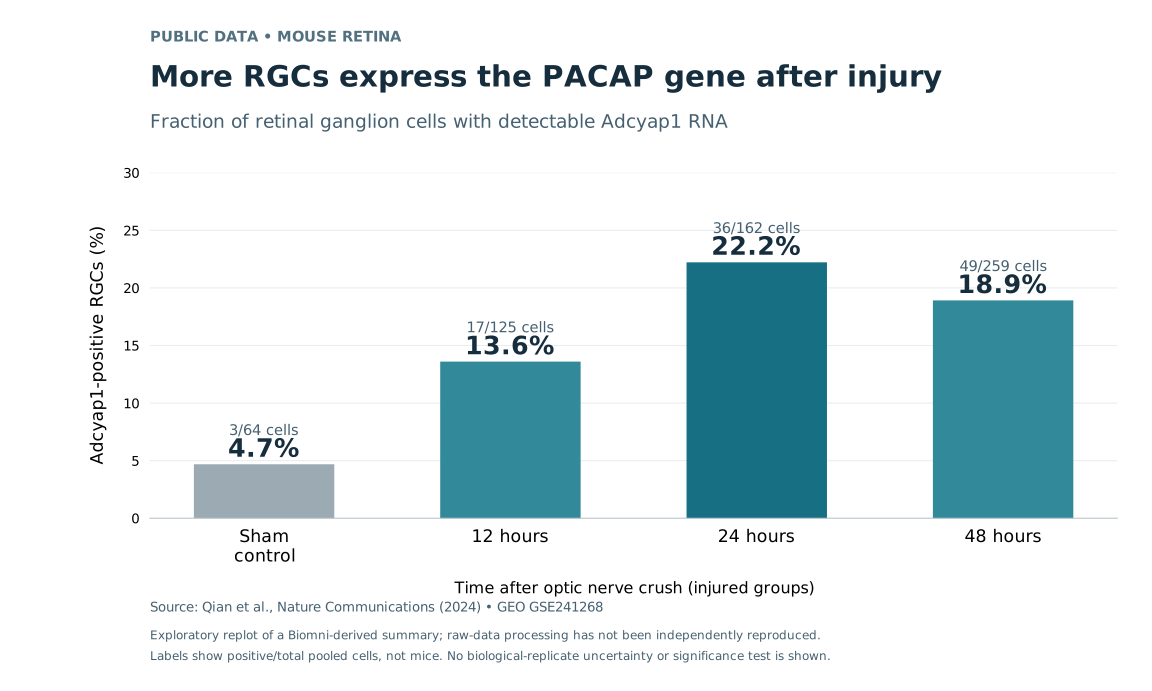
In our reanalysis of public retinal data, the fraction of pooled retinal ganglion cells with detectable Adcyap1 RNA rose from 4.7% in the sham group to 22.2% at 24 hours after optic nerve crush. Adcyap1 is the gene that encodes PACAP.
These descriptive proportions summarize pooled cells. The mouse study separately tests whether administering PACAP affects cell survival.
Source dataset · Qian et al. (GSE241268)